
Dr Liana Chua (2021) argues that field staff deserve to be taken seriously as experts in community engagement in ‘Field Reflections’ – a new collection of accounts from 17 staff from NGOs who work on the ground in Indonesian Borneo to support conservation and development programmes in partnership with local and Indigenous communities.
Dr Chua, who is Tunku Abdul Rahman Associate Professor in Malay World Studies at the University of Cambridge, said:
“Having spent a lot of time looking at encounters between conservation and indigenous and rural communities, the one thing that stood out to our research team was the vital translational and mediatory work done by local conservation staff. In spite of this, the voices of front-line workers have been conspicuously absent from policy forums, academic journals and the boardrooms of NGOs and funding agencies.
“The stories told in ‘Field Reflections’ show that teams working on the ground are the real social experts: professionals whose insights stem from direct engagement with flesh-and-blood humans (and not just abstract units). They deserve to be taken every bit as seriously as the ecologists, economists and other experts whose names tend to dominate academic articles and policy papers.”
The 17 first-hand accounts told as part of ‘Field Reflections’ emerged from ethnographic research training offered by Dr Chua’s colleagues, Dr Viola Schreer and Dr Paul Thung, to field staff to improve their methodological, analytical and writing skills. These sessions were based on a set of resources that they had earlier designed, and made possible by a grant from the University of Cambridge Social Science Impact Fund. The staff who participated in a series of training sessions and a joint workshop came from two community-centred NGOs in Borneo: Yayasan Tambuhak Sinta (YTS) in Central Kalimantan and Yayasan Planet Indonesia (YPI) in West Kalimantan.
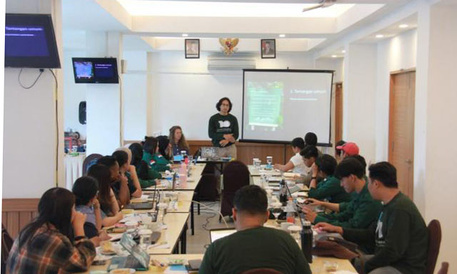
The joint training workshop held with front-line NGO staff in Palangka Raya (credit: YTS)
Dr Chua commented, “The joint workshop gave community engagement teams from YTS and YPI a chance to share experiences and ideas for the first time. They agreed that their work with communities in the field was often invisible and underappreciated, and decided, on the back of this workshop, to create ‘Field Reflections’ to share their stories, experiences and discoveries. The collection of stories shines a light on the care and creativity required to make conservation work not just for wildlife but also for local people.”
The research training was the third in a series of projects focused on community engagement and conservation in which Dr Chua has been involved: she previously led a European Research Council-funded study of the global nexus of orangutan conservation, in tandem with another research project focused on the root causes and contexts of human-orangutan conflict in rural Borneo.
Dr Chua added, “Conservation is an urgent business. But as everyone who contributed to ‘Field Reflections’ is well aware, social engagement for conservation cannot be done in haste. Sometimes it pays to slow down and go back to basics, in order to gain fresh perspectives and generate long-term impacts.”
Reference
Chua, L. ‘Afterword’ in Schreer, V., & Thung, P. H. (Eds.). (2026). Field Reflections: Stories of Community Engagement in Indonesian Borneo. Yayasan Tambuhak Sinta and Yayasan Planet Indonesia. https://doi.org/10.5281/zenodo.19084539
With thanks to St Catharine's College for this news item.