

Interview with Ashley Chin
A haunted tour guide now deceased, a seemingly empty photograph identified as spiritually busy by a ‘seer’, and a death-themed theme park. These three images – taken in Singapore by recent MPhil graduate Ashley Chin – powerfully articulate the city-state’s rich connection to ghost stories and haunted space.
Chin’s "striking" photography caught the attention of this year’s postgraduate photography competition judges, who were impressed by the thoughtful narrative arc, use of light to add texture and depth, and evocative descriptions.
Ashley Chin is a MPhil graduate in Social Anthropological Research, supported by the Hong Leong-Lee Kuan Yew Scholarship. She is the winner of this year’s postgraduate photography competition.
You’ve just graduated with an MPhil in Social Anthropological Research. Can you give an overview of your research?
My research untangles the triangular relationship between ghosts, ghost stories and haunted spaces. I look at how encounters with spirits often give rise to ghost stories and how these have evolved into a form of ghost media, no longer tied to direct encounters. I consider how ghost media, in turn, shape the way haunted places are experienced.
Singapore has been described as a ‘spiritual safari’, rife with exotic entities from its many settler cosmologies – vengeful female vampires (Pontianak), invisible fae (orang bunyian), hungry ghosts, sleep-paralysis ‘sitting ghosts’, even the ghost of a colonial-era German girl on Pulau Ubin.
These ghosts, stories, and spaces sit uneasily at the edges of ‘religion’, operating in ways that both overlap with and spill outside institutional faith.
What first drew you to this topic?
It comes from affection for the ‘weird and cooky’ side of growing up in Singapore. In primary school, my Math teacher used to reward us for finishing sums early with ghost stories. I still remember that mixture of fear and thrill — being so scared we refused to go to the bathroom alone.
That affection for these stories, and the memory of how powerfully they shaped childhood, made me want to take them seriously as an anthropological subject.
Why is Southeast Asia such a fertile site for spectral studies?
There was a viral post on X recently: ‘“You’re an atheist why do you believe in ghosts” try living in southeast asia.’ The reply: the spirits in Southeast Asia do not care if you don’t believe in them, they’re coming for you either way. I think this really gets to the core of it.
Unlike the Western conception of ghosts as undead figures of horror, Southeast Asian spirits are deeply social. They don’t just scare you, they compel action by insisting on ritual attention or narrative circulation. This is why the region — Indonesia, Malaysia, Thailand, Vietnam — became the incubator for spectral studies.
Anthropology is now taking an interest in ‘hauntology’ globally: for example, the theme of this year’s American Anthropological Association (AAA) meeting in New Orleans is “Ghosts”. I think the most compelling insights still come from Southeast Asia, where spirits remain part of everyday life, rather than just metaphors to perform clever analytical tricks with the undead past.
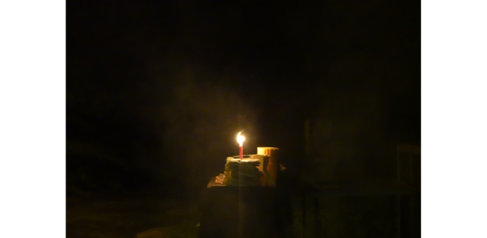
Image: ‘Feasting’ by Ashley Chin
Why did you focus on Singapore? What makes the city-state such an ‘analytical puzzle’?
As a Singaporean, I had a ‘home team advantage’. Something that’s always bugged me about living there is how dizzying life feels. There’s this constant forward thrust with land marked for redevelopment, government planning for future challenges, and techno-futurist architecture dotting the skyline.
Officially, the nation insists she’s only 60 years old — or just over 200 if we count colonial arrival — but the deeper past is often downplayed, positioning Singapore as a product of modernity.
I was intrigued by how, in a city obsessed with progress and forgetting, ghost stories seem out of place. Compared to places like Thailand or Vietnam, where ghosts are deeply institutionalised, Singapore is fascinating because hauntings emerge in the gaps of a carefully curated national history.
You travelled to Singapore for your fieldwork. Can you tell us about this experience?
There’s an overused anthropological cliché everyone loves to parrot: the ethnographer’s job is to make the strange familiar, and the familiar strange. Doing fieldwork “at home” felt like the latter, giving me license to explore haunted spaces I’d always ignored.
I’d only known Haw Par Villa [the world’s only park themed around death and the afterlife] as an overpriced carpark – once we got slapped with a ten-dollar fee just for passing through — but I’d never stepped inside. It was humbling to realise how much I’d overlooked, and how different places feel when I’m there with purpose.
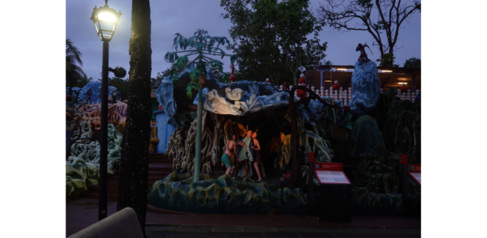
Image: ‘Trapped’ by Ashley Chin
What challenges did you face when working with the intangible, and often private, nature of spiritual encounters?
You can’t engineer a ghost encounter, and that unpredictability is a methodological challenge. Instead of trying to “catch” a spirit, I paid attention to the stories people told, the atmospheres they described, and the spaces those stories animated. That meant approaching the spectral obliquely — through urban legends, media, and the textures of place. In the end, absence itself became analytically productive.
The judges were impressed by the narrative arc in your winning images – from the personal to your broader societal reflections. Were these choices deliberate?
I don’t think I mapped out a narrative arc consciously. I rely on intuition — following a hunch, staying with a feeling, noticing a texture. Anthropology cultivates this instinct, even if we don’t name it. Looking back, I can see the arc: moving from the personal to the interpersonal to the collective. But at the time, it was about trusting intuition.
What do these images reveal that words alone might not capture?
Images resist the neat linearity of text. Writing flattens experience into a left-to-right, up-to-down sequence, while a photograph can hold visual complexity in one frame. Anyone who speaks multiple languages or works with translation knows how impossible it is to capture everything in words. Something is always lost, even as new resonances emerge.
Experience is multi-sensorial: we see, hear, and feel all at once. Images preserve the visual, which is often our most active sense. Writing, by contrast, is a layer removed, always representation.
What role does photography play in your research overall?
Photography is integral for me. I shoot things that catch my attention, and those images help me remember atmospheres that words struggle to fix. They’re both fieldnotes and prompts for writing. I’d love to explore making photo-essays.
To this day, the portraits in Joao Biehl’s Vita continue to haunt me.
Is it important for anthropologists to explore alternative forms of expressions beyond traditional academic writing?
Anthropology is about grasping human experience, and writing can’t capture it all. Writing is where we do our most complex analytical manoeuvres, but other forms — creative nonfiction, photo-essays, graphic novels, documentaries, podcasts — open up different affordances.
Some see these as just ‘public anthropology’, like being interviewed on a podcast or writing for The Guardian, but I think there’s more potential in collaboration and experimentation. For example, Lissa is a graphic novel on medical care in Egypt and the U.S., created by anthropologists at Brown University working with Rhode Island School of Design students. Or Robert Lemelson’s Tajen, a film revisiting Clifford Geertz’s seminal analysis of Balinese cockfighting, was made because students were struggling to connect with the text.
These aren’t supplements to traditional academic writing — they’re other modes of being anthropological.