
At this year’s Cambridge Festival, a unique workshop rooted in anthropologist Sasha Flatau’s fieldwork invited visitors to step into the world of childhood in the Colombian Amazon – seen through the eyes of the children who live there.
Most days, the indigenous Cacua women prepare bread from manioc, a widely cultivated root vegetable. Children start learning the steps – peeling, washing and grating the bitter manioc – from the age of five. By age ten, they can bake the bread independently.
Cacua children grow up working alongside their parents in the fields. Even toddlers under two accompany their mothers. From an early age, children learn through hands-on involvement, and by seven, many are skilled at chopping wood with an axe. On community work days, the whole village comes together to complete collective tasks, such as clearing the paths with machetes. Children work side-by-side with adults.
“In Cacua, there is this word: teo wáac, which means to come together to work,” explainsDr Sasha Flatau, a recent Postdoctoral Research and Teaching Associate in the Department of Social Anthropologyat Cambridge University. “That is really important in childhood and something that all children do from a very early age.”
“It's not just work; it's coming together to work. It's being part of something bigger. It's looking out for others, being unselfish. Labour is a collective act that builds social cohesion and shared purpose. These are the characteristics they want their children to have, and as they get older, they take on more responsibility. This is what it means to be Cacua.”
Living with the Cacua
Flatau’s detailed understanding of the Cacua emerged over 18 months spent living within one community in the Vaupés region of northwest Amazonia, conducting fieldwork towards her PhD. This small indigenous group – with a dispersed population totalling around 400 individuals – now predominantly lives across two village settlements, accessible only by river and rainforest trek.
Historically, the Cacua were nomadic hunters who relocated every one to two years. Over time, this way of life has changed and the largest Cacua community – some 190 inhabitants – visited by Flatau, significantly began to grow in the 1990s.
The Cacua have a complex relationship with the neighbouring indigenous groups, who were locally regarded as higher in social status. In the past, the Cacua were often directed to work for these other groups, in their fields and homes. Today, the Cacua have become more agricultural themselves, cultivating their own land and no longer working for others.
Learning through observation
Flatau immersed herself in the daily lives of the Cacua, observing and gradually learning to take part in their routines. Her research focused on childhood, specifically how children learn informally through everyday experience.
“As an anthropologist, our main research method is participant observation,” she says. “I approached this through three interconnected spheres: community, family life, and children.”
To learn from the first sphere, Flatau would attend every community event: the multi-generational work days as well as information-sharing community meetings, or workshops facilitated by visitors, such as healthcare organisations.
To observe family life, she joined families as they worked together in their fields. She also conducted short interviews in their homes, entirely in the Cacua language. She recorded these conversations and, as her Cacua improved, was able to transcribe them herself, with support from a bilingual local assistant. “That was extremely helpful for understanding family life and the specific terms used – there's never a direct translation.”
The final sphere centred on the children themselves. Flatau engaged with them informally – joining in games and building connections – to gain insight into their daily lives from their own perspectives.
Part of this involved hosting art-led workshops. Activities included drawing, photography, and film making. She was careful to ensure that the children knew these workshops were voluntary, also delivering them in their own indigenous language to differentiate them from Spanish-spoken school lessons. Parents would often describe to Flatau how their children loved the sessions.
Flatau also initiated group conversations, asking all the children the same questions for collective discussion. In one such chat, she asked, ‘What things do bad and good people do?” also asking them to draw their suggestions.
“It was fascinating,” she explains. “In the example of a bad person, a girl had drawn a person in a field pulling up manioc. The girl explained that the person was stealing from another's field.”
“I was able to connect the dots to recent community meetings, where there had been discussions about stealing from people's gardens. Leaders had explicitly said, bad people steal and are lazy. Good people work. If you're stealing from someone else's field, you're stealing from good working people. It's really interesting to be able to piece everything together.”
Cultural crossroads
Missionaries first arrived in Cacua villages in the 1960s, initiating a process of religious conversion. Today, the community is considered evangelical Christian. Alongside religious instruction and formal education, missionaries also introduced external – often Western – ideas about childhood. As community leaders were educated by these missionaries, these influences began to shape, and at times collide with, traditional Cacua concepts of work and childhood.
Flatau also saw a mismatch in understanding when other external organisations – such as those in health or education – visited the community to talk about the rights of children. “They'd say, you mustn't leave your children unsupervised,” she says. “Or you mustn’t let your children go to the fields with you to work with machetes. Children within indigenous communities are very independent. The parents might be hunting or in the fields all day, and a toddler would often be minded by a young sibling.
“I saw clashes between what the law says children should do and what it means to be a Cacua child within community life.”
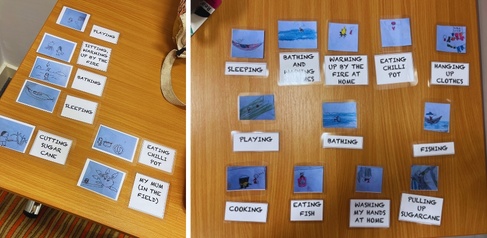
Image: Matching card game using drawings created by the Cacua children to represent their daily lives. Sasha Flatau, March 2025.
Universal childhood?
During her fieldwork, Flatau created an exhibition of the children's artwork for the community, but had always hoped to restage it in the UK. She had this opportunity as part of the Cambridge Festival’s Family Weekend, inviting visiting children and their families to learn about what it means to be a child in the Colombian Amazon.
“It can feel vulnerable sharing your research with a broader public. You don't know if it's going to be misunderstood or how people will perceive you,” she says. “But research is interesting for people outside of academia, it just needs to be communicated in the right way.”
A selection of the Cacua children’s drawings, photographs and descriptions of their everyday lives were displayed, while snippets from a video created for a community event were also projected. Flatau had filmed girls during a typical day, climbing trees to pick fruit or filling pots with water from the river to carry home on their heads.
“I named the Cambridge event, Universal Childhoods?” she explains, “framing it around two questions: What does it mean to be a child in the Colombian Amazon? And what does it mean to be a child to you? I wanted children in the UK to reflect on their own childhood, and on things they might take for granted about what it means to be a child.”
Flatau showed photos and drawings created by the Cacua children to represent their daily lives. This included photos in hammocks, where they slept, and photos taken by the river, where they bathed and washed their clothes. “To the children in Cambridge, I asked them to think about comparisons between their lives and those of Cacua children, for example, how they bathe or where they sleep,” she recalls.
“Children in the UK would be surprised that the Cacua washed in the river or used machetes,” says Flatau. “One girl had just turned four and was fascinated, asking how old all the children were. She said to her mum, look that girl is only six and she's doing that. She compared herself to the Cacua.”
There were some unexpected comments, too, including one that described ‘poverty’ as ‘horrible’. “That was interesting because nowhere had I mentioned poverty. Nowhere had the Cacua children mentioned poverty about their own lives; they never did. The children in Cambridge had made that assumption.”
Lastly, Flatau used a whiteboard to prompt questions. “In one example the children responded, we don't work like these children do. We don't work as hard as them.”
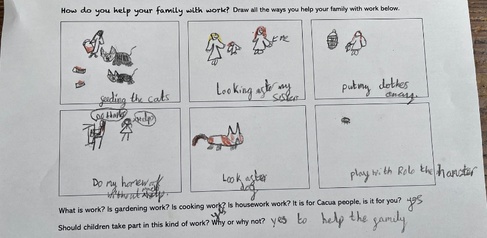
Image: Children draw the ways they help their families with work as part of the Cambridge Festival’s Family Weekend. Sasha Flatau, 2025.
Rethinking difference
Flatau’s project invited visiting children and their families to question what is considered ‘universal’ about childhood. By drawing in the voices and perspectives of Cacua children, she highlighted the vast social and cultural diversity in children's daily lives – how they play, grow up, and how they understand concepts like work. Yet, she also revealed the assumptions many carry, particularly around ideas like comfort, poverty, and what types of work are deemed appropriate for children.
“Looking at the Cacua children made the children in the UK question what could be different. There's not one way of living, it can be different,” says Flatau.
“We have a biological understanding of what it means to be a child. Yet there are so many ways to experience childhood. It’s helpful to question societal norms that dictate what a child should do or should be.”
“While certain ideas on childhood are presented as universal, research like mine clearly shows that it is not. Some might claim that if you don't fit the requirements of this universal model, then you have been robbed of a childhood. That wasn’t what I found in my research. I believe the Cacua have an incredible childhood.”
‘Universal Childhoods?’ took place on 29 and 30 March 2025 as part of theCambridge Festival’s Family Weekend.
Thank you to Flora Foltanyi, the Festival volunteer who helped with the event, engaging the visiting children and their families. Thank you also to Jennifer Williams, the Public Engagement Coordinator, responsible for the Family Weekend.
Words by Joanne Dodd, Communications Coordinator in the School of Humanities and Social Sciences, University of Cambridge.
Lead image: Children take part in a workshop as part of the Cambridge Festival’s Family Weekend. Sasha Flatau, March 2025.