
As Senegal’s capital transforms at pace, an exhibition explores everyday life and uncertainty in a centrally located informal settlement of Dakar undergoing resettlement. It was developed and curated by Dr Anna Wood in collaboration with Dakar-based photographers Djibril Dramé and Katia Golovko.
Every time Dr Anna Wood returns to Dakar, the Senegalese capital, the skyline has changed. Single storey buildings are replaced by high-rise developments. Major infrastructure projects cut through the city. For many informal settlements across the city, the pace of change brings new uncertainties.
The exhibition emerges from Wood’s long-term research in Taïba, a small piece of land gifted to residents in the mid-20th century by a local leader during early waves of urbanisation. At the time, it lay at the city’s edge surrounded by open fields. Its now-central location has become highly valuable leading to its sale for development.
Residents face relocation as part of a national housing programme aiming to build 100,000 new homes across the country. They have long been promised either social housing on the outskirts of the city or financial compensation, yet timelines and outcomes remain unclear.
“Taïba’s inhabitants do not know when they’ll be moved,” says Wood, a Research Associate in the Department of Social Anthropology. “There are different rumours and so there’s this tension; it might be imminent or it might not happen. I’ve been following this protracted wait.”
Wood first travelled to Dakar in 2017 to complete her PhD fieldwork. She spent around two years in the capital, researching new forms of social protection and welfare linked to large-scale state projects. For a time, she lived opposite Taïba, becoming closely involved in everyday life and developing long-standing relationships with residents.
“Some inhabitants want to remain where they were born and grew up, where they work, where they have ties,” explains Wood. “But for most, the idea of being given a home or owning a home would have been previously unthinkable. There's a real impatience for it to happen and an anxiety that it won’t.”
In collaboration with two Dakar-based photographers, Djibril Dramé and Katia Golovko, Wood initiated Xolu Dakar bi as a collaborative exhibition project rooted in visual documentation of everyday life amid uncertainty about the move.
Golovko, a researcher, writer and photographer who has lived in Dakar for over a decade, has built a photographic archive of the buildings and urban spaces already lost to development. Her images for the project focused on architectural spaces and urban transformation. Dramé, a Senegalese visual artist and curator, worked closely with residents, bringing together portraits, domesticity and stories of place.
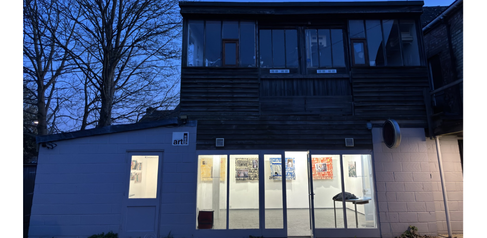
The resulting works were displayed in a four-day exhibition – Xolu Dakar bi (The Heart of Dakar) – at Cambridge Artspace during the 2025 Cambridge Festival. The team are now exploring possibilities for adapting the exhibition for a Dakar-based gallery.
One of the images shows a high-rise under construction as seen from Taïba. “These are going up across the neighbouring areas, giving a sense of the pace of development,” says Wood. Another shows a faded house number on a wall, originally painted during a census linked to the planned resettlement.
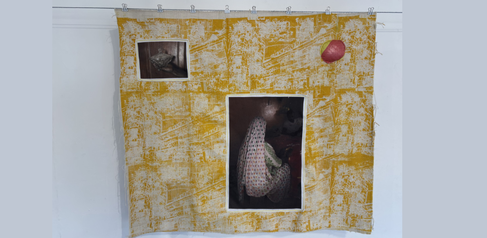
Image: Yellow. objets domestiques. Dramé. Women have been buying and storing domestic items in preparation for the move. Screen printing on rabaal (traditional Senegalese fabric), with photographs and embroidery.
Dramé blended digital images with craft techniques like embroidery and screen printing. In one piece – Yellow. objets domestiques – he photographed a resident in her home, who like other women, had been quietly collecting domestic objects in anticipation of the move. These objects – pots, pans and bowls – were stored under beds and on top of cupboards. “I hadn't been aware of this during my fieldwork and wouldn't have discovered it without the exhibition,” says Wood.
The exhibition – a first for Wood – has opened up new avenues in her research. It brought her work to a new public audience and sparked unforeseen research connections across the University. It has also encouraged her to experiment with visual formats, beyond academic writing, to engage further with her subject matter.
Dr Anna Wood is an anthropologist whose research explores welfare, politics, and development in Senegal. She completed her PhD in Social Anthropology at the University of Cambridge, where she is now a Research Associate and the Department of Social Anthropology’s Knowledge Exchange and Funding Facilitator. She is a By-Fellow of Churchill College, Cambridge.
Xolu Dakar bi (the heart of Dakar) was held at Cambridge Artspace from 27-30 March 2025. It was generously supported by the Public Engagement Starter Fund and Churchill College, both University of Cambridge. The exhibition’s images and works were taken and produced between December 2024 and February 2025. The project has informed Dr Anna Wood’s new research on social housing more broadly in Dakar.
Lead images, l-r: High rise image, Golovko. Tower block under construction, as seen from Taïba. 35mm photograph.
House number image, Golovko. House number painted during an early census linked to planned resettlement. 35mm photograph.
Words: Joanne Dodd, Communications Coordinator, School of Humanities and Social Sciences, University of Cambridge